

Aprende en Comunidad
Avalados por :





¡Acceso SAP S/4HANA desde $100!
Acceso a SAPPrinciples and Best Practices for Clean Code: A Beginner's Guide
- Creado 01/03/2024
- Modificado 01/03/2024
- 13 Vistas
Clean code is a term used to describe software that is easy to read, understand, maintain and test. In this blog I want to summarize some important principles and provide an entry into the topic for beginners. Besides, the blog shall connect to the style guide repository, the books and current initiatives where experts can contribute. If you do not want to miss an update on clean code, test automation, code reviews, unit testing, decision making, testability and other engineering / craftsmanship / architecture topics, subscribe to the brand new newsletter .
What makes code clean?
Achieving clean code involves following a set of best practices and standards, such as using meaningful names, keeping functions small and focused, and using comments sparingly. Having a code base, which is readable and maintainable is essential for sustainable development. The books Clean Code from Robert C. Martin, Code Complete from Steve McConnell, The Pragmatic Programmer from David Thomas/Andy Hunt, and some other books contain many best practices and examples for clean code.
What is code that’s not clean?
Code that is not clean is code that is difficult to read, understand, and maintain. It may have poor organization, confusing or misleading names, inconsistent styling, and other issues that make it harder to work with.
Some examples of code that is not clean might include:
- Code with long, complex functions that are difficult to understand, test and maintain.
- Code with poor naming conventions, such as variables with short, non-descriptive names, or functions with names that do not accurately reflect their purpose.
- Code with inconsistent styling, such as inconsistent indentation or spacing, which can make it harder to read and understand.
- Code with unnecessary or redundant code, which can make it harder to maintain and understand.
- Code which making test automation hard, e.g. static coupling between classes.
Overall, code that is not clean is often more prone to errors and bugs, and can be more time-consuming to work with, as it requires more effort to understand, test and maintain.
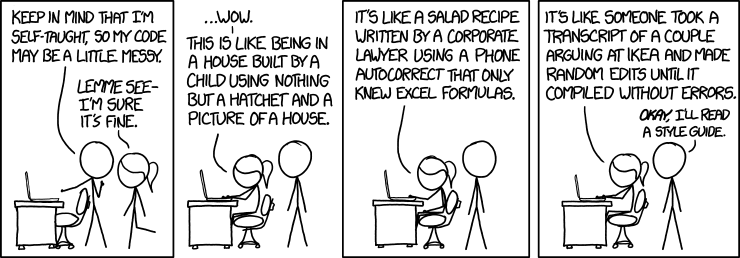
Code Quality from xkcd.com/1513/ under Creative Commons BY-ND 2.5
Benefits of Clean Code
There are many benefits to writing clean code, including:
- Improved readability and understandability: Clean code is easier to read and understand, which can make it easier for developers to adapt, debug, and maintain.
- Reduced risk of errors and bugs: Clean code is generally more reliable and less prone to errors and bugs, as it is easier to understand, test and maintain.
- Increased productivity: Clean code is easier and faster to work with, which can increase developer productivity and efficiency. According to a meta study unhealthy code can contain more than 15 times more defects and reduce productivity by a factor of 9 .
- Increased ability to adapt and evolve: Clean, modular code is easier to modify and update, which can help the software evolve and adapt to changing requirements over time.
- Improved team collaboration: Clean code is easier for team members to understand and work with, which can improve collaboration and communication within the team.
- Better long-term maintainability: Clean code is easier to maintain and update over time, which can save time and resources. And reduce risk if engineers move to other projects or leave the company.
- Increased code reuse: Clean, modular code is easier to reuse and repurpose in different contexts, which can save time and resources.
- Better performance: Clean code is generally more efficient and can run faster, as it is less complex and easier to optimize when needed.
- Improved code review process: Clean code is easier to review, as it is more organized and easier to understand. This can lead to more efficient and effective code reviews.
- Enhanced reputation: Writing clean code can help enhance the reputation of the developer or development team, as it demonstrates a commitment to quality and professionalism.
- A new additional reason emerges for writing clean code. Better Support by Generative AI: Tools like GitHub CoPilot can produce more accurate and relevant code suggestions when the code is clear and expressive.
Overall, clean code can help ensure that your software is reliable, maintainable, and easy to work with, which can lead to increased efficiency, productivity, higher quality, and higher satisfaction of developers and users alike. The benefits of clean code extend beyond just the development process and can have a positive impact on the long-term success of the software and the team working on it.

Sin respuestas
 No hay respuestas para mostrar
Se el primero en responder
No hay respuestas para mostrar
Se el primero en responder
Alianzas / Partners:


contacto@primeconsultor.com
+1 (305) 285-8622
© 2025 Todos los derechos reservados.
Desarrollado por Prime Consultor